
Why Your Products Aren’t Showing Up in AI Answers
Consumers are no longer starting with your website. They are starting with AI.

When shoppers ask ChatGPT, Gemini, Claude, or Perplexity what to buy, those systems do not browse your site the way a human does.
They don't scroll through your site, respond to your design, or give you the benefit of the doubt. They parse structured data, compare descriptions semantically, and make recommendation decisions in milliseconds — based entirely on what your catalog says, how clearly it says it, and whether the broader internet agrees.
Most brands do not know how well they perform on any of those dimensions, and our benchmarks suggest that many don’t fare particularly well! The Commerce Eligibility Index will quantify where you stand.
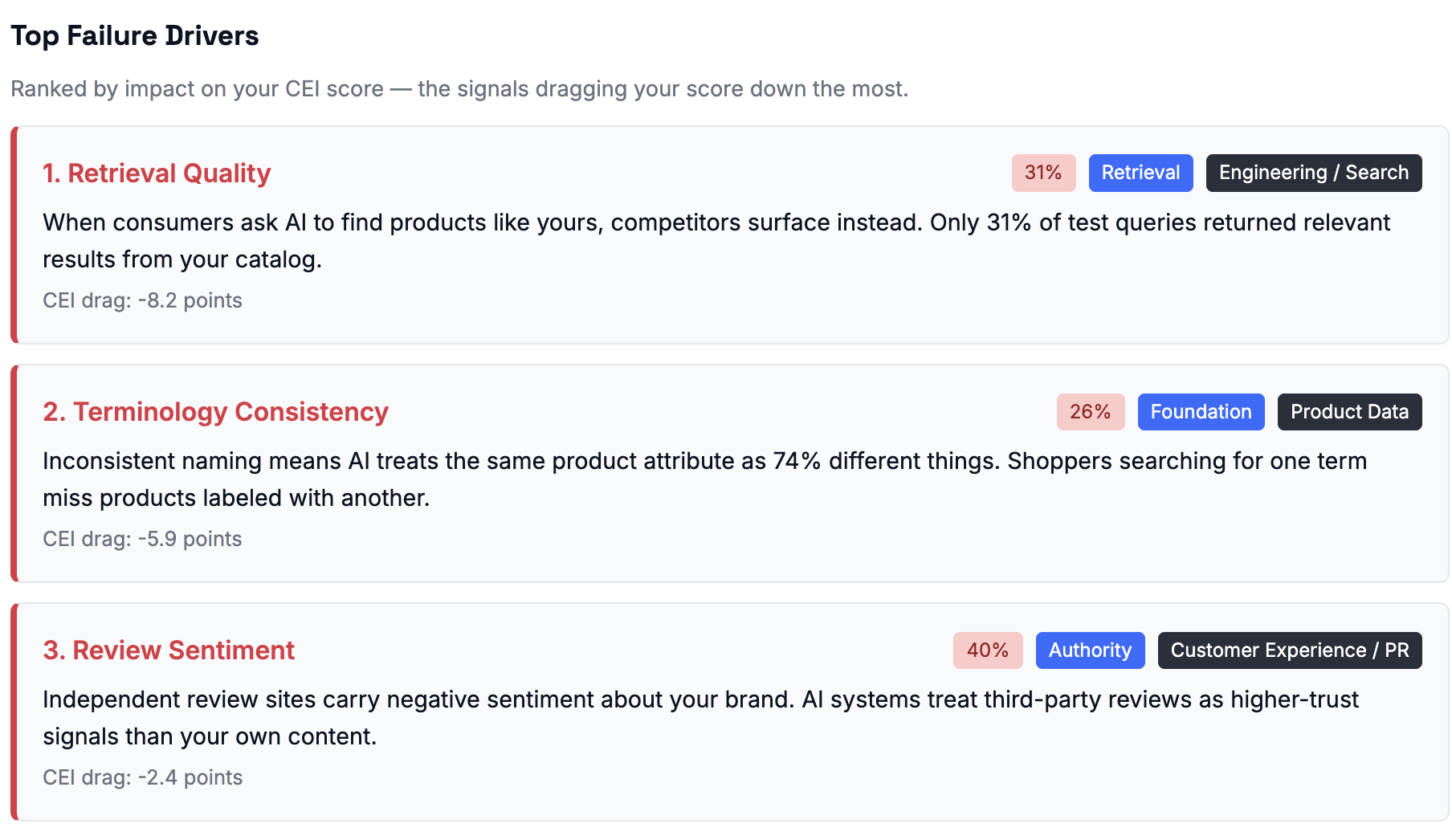
Missing attributes make products ineligible
If key product attributes are incomplete, inconsistent, or hard to extract, AI may never consider your product in the first place.
If a shopper asks for waterproof hiking boots under $150 with a wide fit, an AI system needs those attributes to be explicit and machine-readable. If even one is missing, inconsistent, or buried in paragraph copy, your product may not appear. Not because it lost, but because it was never eligible to be considered.
Generic descriptions erase differentiation
When every product in a category sounds the same, AI has little basis for deciding why yours is the better recommendation for a specific use case.
If your descriptions are vague, repetitive, or interchangeable with competitors, AI has less reason to surface your products confidently. Catalogs with clearer differentiation have an advantage.
Unverified claims reduce trust
AI systems increasingly compare product claims against other sources. Unsupported specifications, conflicting measurements, and vague language weaken confidence.
When product truth is inconsistent across PDPs, feeds, FAQs, reviews, and third-party sources, AI may down-rank your claims or fill in the gaps incorrectly. That creates risk not just of exclusion, but of misrepresentation.
Weak external signals limit discoverability
AI does not rely only on your website. It also learns from reviews, retailer listings, forums, editorial mentions, videos, and other public signals across the web.
If your products have little external presence, few corroborating references, or inconsistent signals across sources, AI has less evidence to cite and less confidence in recommending you.
This is not just an SEO problem
SEO helps pages rank. AI recommendation systems work differently. They depend on whether your product truth is extractable, consistent, trustworthy, and easy to reconcile across sources.
That means the issue is deeper than rankings or clicks. It sits in your product data, your catalog structure, and the signals AI uses to decide what belongs in an answer.
CatalogSignal makes it visible
CatalogSignal measures how discoverable your catalog is in AI-powered search through the Commerce Eligibility Index, or CEI.
CEI shows where your catalog is strong, where it breaks down, and what to fix first so your products are more likely to appear accurately in AI-generated recommendations.